How Meta’s Alberta Data Centre Could Impact Electricity Prices for Businesses
A single large data centre can use as much electricity as a city. Meta’s planned project in Sturgeon County, north of Edmonton, could become one of the biggest new power users in Alberta.
The facility is planned as a 1-gigawatt data centre. That means 1,000 megawatts of electricity demand. It could later scale to 1.8 gigawatts. For Alberta businesses, the key issue is timing. If that demand connects to the grid before new dedicated power supply is fully built, the market could tighten.
That matters for any business on a floating or unhedged electricity plan. It also matters for large commercial sites with high power use. More demand can mean more price swings, higher wholesale prices, and less room for error in energy budgets.
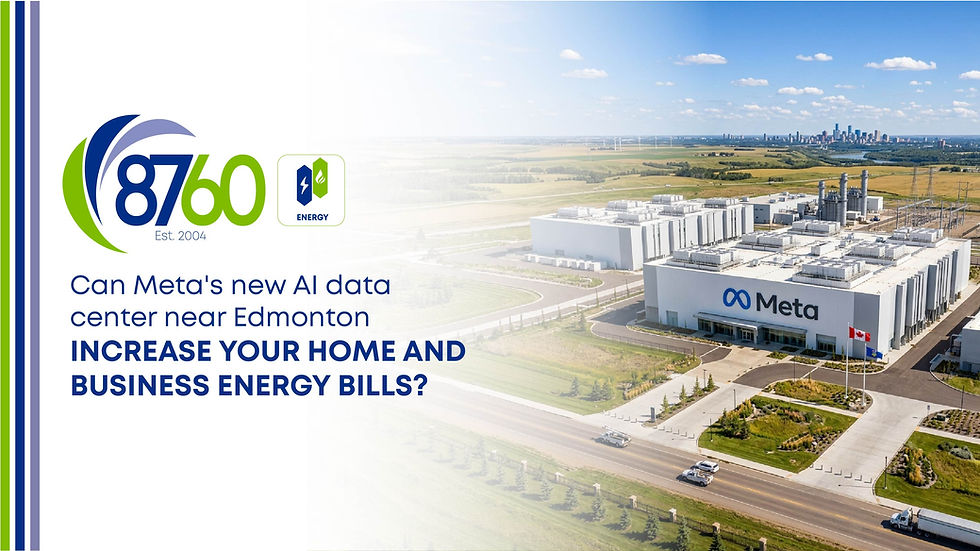
Why Meta’s planned data centre matters to Alberta’s power market and commercial electricity prices
Meta’s planned Sturgeon County data centre is part of a larger wave of artificial intelligence infrastructure. These facilities need steady, large-scale power. They operate around the clock. Their electricity use does not rise and fall like a typical commercial building.
That steady demand changes the way the power market behaves.
Alberta’s electricity market already moves with weather, plant outages, fuel costs, and demand from homes and businesses. A very large new customer can add pressure, especially if it draws power before its own generation is ready.
A recent Pembina Institute analysis flagged this issue. Under current provincial rules, very large facilities can connect to Alberta’s grid before their dedicated generation plants are fully built. The analysis points to a possible grid draw of up to 970 megawatts from the planned data centre.
That is a major amount of power.
For context, one megawatt can serve many homes at once, depending on the time of day and season. A load near 970 megawatts is not a small industrial addition. It is a major new demand source.
The concern is not only total power use. It is the near-term timing.
If demand arrives before enough new supply is available, the market has to balance itself with the power plants already operating. That can push prices higher during tight hours. It can also make prices harder to predict.
How wholesale electricity price pressure can reach business bills
Alberta has a wholesale electricity market. The wholesale price is often called the pool price. It changes hour by hour based on supply and demand.
When supply is tight, the price can rise. When supply is plentiful, the price can fall.
According to the Pembina Institute backgrounder, major Alberta power producers Capital Power and TransAlta have forecast wholesale pool prices could rise to as much as $100 per megawatt-hour over the next couple of years. One megawatt-hour is equal to 1,000 kilowatt-hours. A kilowatt-hour is the unit most customers see on bills. Residential electricity bills in Alberta could rise by $267 to $462 per year (a 15% to 25% increase) due to grid pressures.
That does not mean every business bill will instantly jump to that number. Retail contracts, fixed rates, delivery charges, and usage patterns all matter. But higher wholesale prices can still show up in several ways.
Businesses may see pressure through:
Higher floating electricity costs
More frequent price swings
Less attractive renewal offers
Wider gaps between fixed and floating options
Higher budget risk for large sites with heavy power use
A business on a fixed-rate contract has more protection from wholesale price swings during the contract term. A business on a floating plan has more direct exposure. Large commercial sites that buy power in stages or manage more complex contracts need to watch the market closely.
The main risk is not one high-price hour. The main risk is a tighter market that makes power budgets harder to control.

Why floating and unhedged plans carry more risk now
A floating electricity plan moves with the market. When market prices are low, that can work well. When prices rise, costs rise too.
An unhedged business is exposed to market movement without enough fixed-price protection. That exposure can be a problem when the market faces new pressure.
For a small business, the risk may show up as a higher monthly bill and less cash flow certainty. For a large commercial energy site, the impact can be much larger. High-use facilities can feel even small price changes across many meters, shifts, and locations.
This is where planning matters.
Businesses should review three core questions now:
How much electricity is exposed to floating prices?
If a large share of usage floats with the market, price swings can hit quickly.
When do current contracts renew?
A renewal during a tighter market can create higher pricing pressure.
Which sites use the most power?
A few high-usage sites often drive most of the cost.
This is not about panic buying. It is about knowing the exposure before the market becomes harder to manage.
A basic bill review is a good start. A stronger plan looks at usage patterns, delivery charges, contract timing, and efficiency opportunities together.
What Alberta businesses should do before market conditions change
Energy cost control works best before prices rise. Once the market tightens, options can narrow. For large commercial energy users, the first step is a clear buying plan. That plan should match the business, not a generic rate sheet. A good energy strategy should cover four areas.
Review Commercial Electricity and Natural Gas Procurement Before Renewal Pressure Builds
Electricity procurement means how a business buys power. This can include fixed rates, floating rates, blended plans, or staged purchasing.
Large facilities should avoid making this decision only at renewal time. Waiting until the last minute can limit choices.
With changing demand in Alberta, businesses should compare:
Fixed-rate protection
Floating price exposure
Contract length
Renewal dates
Site-by-site usage
Risk tolerance
8760 offering large commercial energy procurement and commodity strategy across Alberta. With more than 30,000 energy sites managed, the approach uses buying power and market knowledge to help secure better pricing and contract terms for each facility.
The goal is simple. Reduce surprise costs and improve control.
Review Commercial Electricity Delivery Charges Line by Line
Electricity bills include more than the energy price. Delivery charges cover the cost to move power through the system. These charges can include transmission and distribution costs.
Many businesses focus only on the energy rate. That can leave savings untouched.
8760 estimates that 1 in 3 commercial sites in Alberta overpay on transmission and distribution charges. A line-by-line review can find billing errors, rate class issues, and other avoidable costs.
This matters more when energy prices are volatile. Every dollar recovered or reduced helps protect the total bill.
Reduce baseline consumption without hurting output
Energy efficiency is not only about upgrades. It starts with knowing where power is being used and when.
A site benchmark compares current energy use with what the site should be using. This can reveal waste from equipment schedules, heating and cooling settings, compressed air leaks, lighting, motors, or process loads.
For a large site, even a small reduction in baseline use can produce meaningful savings. For a small business, better control can make fixed-rate planning easier.
The target is not lower output. The target is lower waste.

Fixed-rate options can help small businesses and homes manage risk
Not every business needs a complex energy plan. Many small businesses need clear rates, fair terms, and protection from price swings.
Fixed-rate electricity and natural gas plans can help with budget certainty. A fixed term does not remove every charge from the bill, but it can protect the energy rate for the chosen term.
8760’s Small Business Energy Program and Home Energy Program include fixed-rate options for electricity and natural gas. Rates are updated monthly. Plans are available for 1-, 3-, or 5-year terms.
The rates below are the lowest listed in the provided rate update. Confirm current pricing before signing, since published rates can change.
Home energy rates in Alberta as of September 1, 2026 — click to sign up here.
Energy type | 1-year fixed | 3-year fixed | 5-year fixed |
Residential electricity | 7.08 ¢/kWh | 8.08 ¢/kWh | 9.48 ¢/kWh |
Residential natural gas | $3.28/GJ | $3.68/GJ | $3.88/GJ |
Small business energy rates in Alberta as of September 1, 2026 — click to sign up here.
Energy type | 1-year fixed | 3-year fixed | 5-year fixed |
Small business electricity | 7.68 ¢/kWh | 8.88 ¢/kWh | 9.98 ¢/kWh |
Small business natural gas | $3.88/GJ | $4.28/GJ | $4.38/GJ |
Kilowatt-hours, shown as kWh, measure electricity use. Gigajoules, shown as GJ, measure natural gas use.
For small businesses, fixed-rate protection can make monthly costs easier to forecast. For homes, it can offer the same benefit during colder months or periods of market concern.
The key is transparency. Know the rate, the term, the fees, and the renewal process before signing.
What 8760 looks at in a full energy review
A strong energy plan looks at the whole bill, not one line.
8760 works as an independent energy management partner for businesses across Alberta. The focus is practical cost control. That includes buying strategy, billing review, and reducing waste.
The Large Commercial Energy Program takes a full view of energy costs:
Large commercial procurement Build a buying plan based on site usage, market conditions, and contract timing.
Commodity strategy Decide how much energy to fix, float, or stage over time.
Delivery charge reviews Audit transmission and distribution charges to identify possible overpayment.
Energy efficiency audits Benchmark sites and find ways to reduce baseline use without reducing output.
Small business and home programs Offer fixed-rate electricity and natural gas plans with monthly rate transparency.
This type of planning matters more when large new demand is coming to the province. Meta’s Alberta data centre could impact electricity prices for businesses because the grid may need to serve a major load before new dedicated supply is fully in place.
Waiting for price changes to appear on the bill is a weak position. Reviewing exposure now gives businesses more options.
FAQ
Will Meta’s data centre definitely raise my electricity bill?
Not directly in every case. The impact depends on your contract, usage, and rate type. But added demand can tighten the market, which can raise risk for floating or renewing customers.
What is a floating electricity plan?
A floating plan changes with market prices. If wholesale prices rise, your energy rate can rise too. It can save money in low-price periods, but it carries more risk in volatile markets.
Are fixed rates always better?
No. Fixed rates offer budget certainty, but floating rates can be lower at times. The right choice depends on usage, risk tolerance, and current market prices.
Why should delivery charges be reviewed?
Delivery charges are a major part of many commercial power bills. Billing issues or rate class problems can lead to overpayment. A review can find savings that have nothing to do with the energy rate.
When should a business review its energy plan?
Review it before renewal, before major site changes, and when market conditions shift. With large new power demand expected in Alberta, reviewing now is a practical step.

Alberta’s power market is entering a period of change. A large data centre north of Edmonton could add major demand. New supply may not arrive at the same pace.
Businesses do not need to guess what happens next. They need to know their exposure, review their contracts, check delivery charges, and reduce waste where possible.
The best time to prepare for electricity price volatility is before it reaches the bill.


Comments